Puroxi Knowledge Centre
How to Choose the Right Water Treatment Technology: UV, Ozone, Nanobubbles or Ultrasonic?
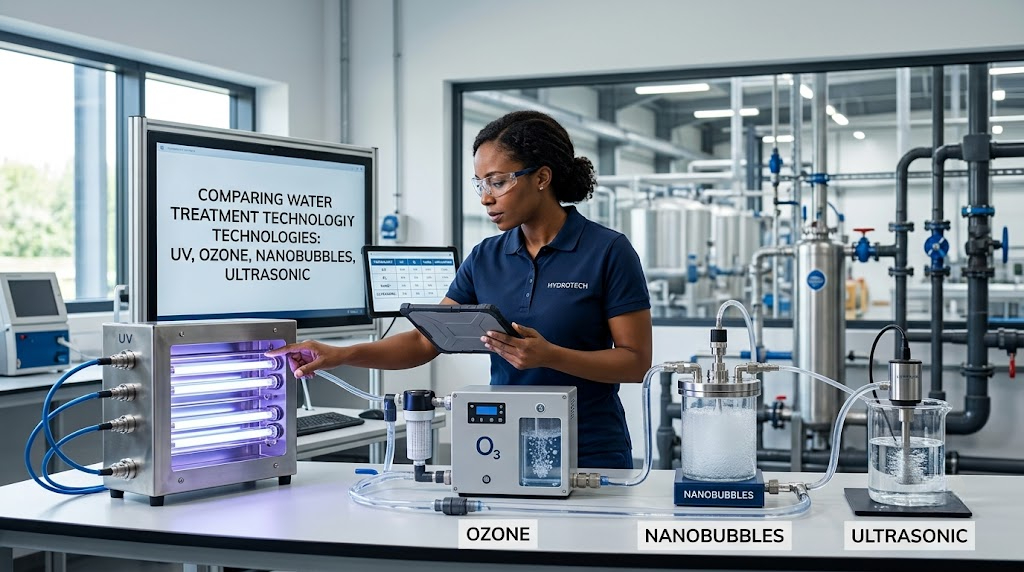
Choosing the right water treatment system can be daunting. Utilities, industries, farms, and aquaculture have multiple technologies to choose from. Any of the following systems can support your water quality goals: UV, Ozone, nanobubbles, and ultrasonic. However, each technology is unique.
Thus, water source, contaminants, treatment objectives, flow rate, energy requirements, and operating conditions are key factors to consider when comparing water treatment technologies. The best option will address a particular need, not just the latest technology.
Water Treatment Technology Comparison: What Should You Consider?
Before choosing equipment, define the desired outcomes for the treatment system. Various technologies address various water quality issues.
Start by evaluating:
- Type and concentration of contaminants
- Required treatment capacity
- Disinfection requirements
- Organic and biological load
- Algae concerns
- Odor problems
- Available energy
- Maintenance requirements
- Chemical reduction goals
- Existing treatment equipment
For instance, UV mainly inactivates microorganisms using light; ozone is a highly effective oxidant and disinfectant. When combined with ozone, nanobubbles can enhance gas transfer and can aid oxidation. Ultrasonic systems can target algae and address some physical treatment problems.
So, the last decision should be based on the application requirements.
UV vs Ozone Water Treatment: Which Is Better?
Primary Disinfection vs Residual Protection
When properly designed, validated, operated, and maintained, UV can inactivate susceptible microorganisms without adding a disinfectant chemical at the UV treatment stage. However, UV leaves no residual protection in the treated water, so an additional residual disinfectant may still be required where water is stored or distributed.
UV and ozone can provide effective primary disinfection when systems are properly designed, validated, operated, and maintained. However, neither technology should automatically be assumed to provide continuing protection after the initial treatment stage.
UV inactivates susceptible microorganisms as water passes through the UV reactor, but it leaves no disinfectant residual in the treated water. Ozone is a powerful oxidant and disinfectant, but it generally decomposes rapidly and normally does not maintain a durable residual throughout storage tanks or distribution piping.
Where treated water will be stored, recirculated, or distributed—or where there is a risk of downstream microbial regrowth or recontamination—a compatible residual disinfectant or additional treatment barrier may still be required. Depending on the application and applicable regulations, this may include chlorine, chloramine, chlorine dioxide, hydrogen peroxide, or another approved treatment method.
Hydrogen peroxide is generally introduced by controlled liquid dosing upstream of the treatment process rather than through the gas ports of a Puroxi Nano Bubble Nozzle. The nozzle’s intense mixing may help distribute hydrogen peroxide throughout the water, while oxygen nanobubbles may provide sustained oxygen availability. Determine the appropriate combination and dosage through water analysis, testing, and application-specific engineering.
UV may be suitable when:
- No chemical disinfectant addition is desired at the UV treatment stage, and either no residual is required, or residual disinfection is provided separately
- Targeted microbial inactivation is the primary objective
- The water has adequate UV transmittance
- The required UV dose can be validated and monitored
- A compact point-of-treatment disinfection stage is needed
- No continuing residual is required, or residual protection is provided separately
Ozone may be suitable when:
- Both oxidation and primary disinfection are required
- Odour, colour, iron, manganese, or selected organic contaminants require treatment
- The water chemistry is suitable for ozone
- Adequate ozone contact time and off-gas management can be provided
- Any requirement for downstream residual protection is addressed separately
- Ozone can help oxidize or transform certain organic contaminants
In some systems, UV and ozone can complement other treatment processes rather than competing directly.
Nanobubble vs Ozone: Understanding the Difference
The nanobubble vs ozone comparison requires an important distinction. Nanobubbles describe a delivery and gas-transfer technology, while ozone is a treatment gas with strong oxidation properties.
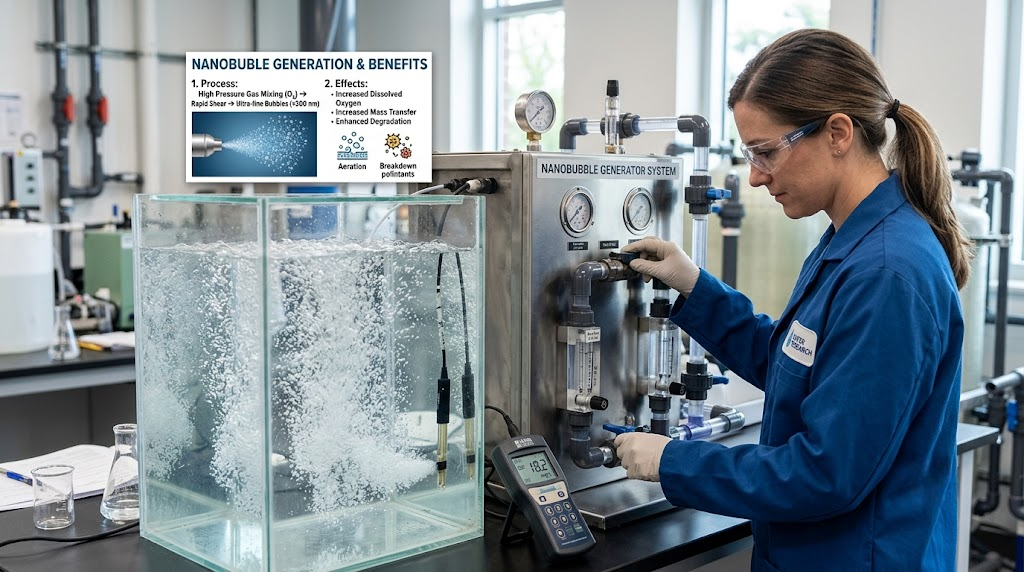
Nanobubbles can transfer gases like oxygen and ozone into water. Because they are very small, they create a large gas-liquid contact area. Nanobubbles may increase gas–water contact and gas-transfer efficiency compared with conventional coarse bubbles, depending on the gas, water chemistry, pressure, flow, and system design. Nanobubbles are a delivery and mixing platform—not a disinfectant on their own. Oxygen nanobubbles should not be described as disinfecting water unless application-specific evidence supports it.
Puroxi offers nanobubble systems that can work with oxygen, air, ozone, and other process gases. Its systems target applications including wastewater aquaculture, irrigation, and industrial water treatment.
Nanobubbles can help with:
- Efficient gas transfer
- Oxygenation
- Ozone delivery
- Gas retention
- Improved mixing
- Reduced gas loss
- Water-quality management
Ozone, meanwhile, supplies oxidative action. Combining ozone with nanobubble technology can therefore provide both oxidation and enhanced gas transfer.
How Nanobubble Technology Works
Nanobubble systems create extremely small gas bubbles within water. These bubbles behave differently from conventional large bubbles.
They can remain suspended for longer periods and provide a large gas-water interface. This characteristic can improve gas transfer throughout the treatment process.
Puroxi’s nanobubble systems use different generation methods, including pressure dissolution, swirl-flow dynamics, venturi injection, and ultrafine-pore generation. The company offers inline, column, and high-capacity configurations.
Choose a nanobubble system when you need:
- Efficient oxygen transfer
- Ozone integration
- Extended gas-water interaction
- Inline treatment
- Large-volume water treatment
- Better gas utilization
The treatment system should be chosen based on water volume, flow conditions, treatment goals, and infrastructure.
Where Does Ultrasonic Water Treatment Fit?
Ultrasonic treatment uses sound wave energy to produce a physical effect in water. It can be used for algae control, some fouling control processes, etc.
Ultrasonic technology can be particularly useful when algae represent a recurring challenge. Puroxi also provides ultrasonic treatment products for algae applications.
Ultrasonic technology may fit applications involving:
- Algae management
- Pond and reservoir applications
- Continuous algae-control programs
- Treatment programs intended to reduce chemical use
But ultrasonic treatment is not a substitute for disinfection and oxidation technologies. To choose the right option, consider the problem at hand. Ultrasonic algae control should not be presented as disinfection.
Best Water Treatment System: How Do You Decide?
No single water treatment system suits all applications. The best answer depends on your water chemistry and treatment goals.
For example, a plant primarily trying to inactivate susceptible microorganisms might consider UV. Another facility dealing with oxidation and odour may consider ozone. A system seeking better oxygen or ozone transfer may benefit from nanobubbles.
Use this simple decision guide:
- Choose UV for validated point-of-treatment microbial inactivation, recognizing that UV provides no downstream disinfectant residual.
- Choose ozone for oxidation and primary disinfection, recognizing that ozone generally does not provide a durable distribution-system residual.
- Consider a residual disinfectant where water will be stored, recirculated, or distributed and may be exposed to microbial regrowth or recontamination.
- Choose nanobubbles to improve the transfer and dispersion of suitable gases, including oxygen or ozone.
- Consider hydrogen peroxide dosing for suitable oxidation or disinfection applications, with the liquid peroxide normally dosed upstream of the Nano Bubble Nozzle.
- Choose ultrasonic technology for suitable algae-management applications, not as a substitute for required microbial disinfection.
- Use a multi-barrier treatment approach when one technology cannot meet all treatment, residual-protection, and regulatory requirements.
Puroxi also combines oxygen and ozone systems with nano-, fine-, and ultra-fine-bubble technologies to improve gas transfer and treatment performance.
Energy, Maintenance, and Operating Costs Matter
Performance is only one part of a technology decision. Long-term operating costs also matter.
A system with excellent treatment performance may not suit a facility if it requires excessive energy or frequent maintenance.
Compare these factors before purchasing:
- Initial equipment cost
- Energy consumption
- Maintenance frequency
- Replacement components
- Chemical requirements
- Installation complexity
- Available space
- Expected operating life
- System scalability
- Integration with existing equipment
A complete evaluation can help prevent expensive technology mismatches.
Why Customized Treatment Often Works Better
Water conditions vary significantly from one site to another. Two facilities may have similar flow rates but completely different treatment challenges.
Therefore, selecting equipment based only on capacity can lead to poor results.
Puroxi emphasizes application-specific system selection. Its nanobubble platform includes different designs for inline systems, controlled treatment environments, and large-volume applications.
A customized evaluation should consider:
- Water analysis
- Treatment objectives
- Flow and pressure
- Contaminant levels
- Existing equipment
- Energy availability
- Installation requirements
- Future capacity
This approach helps identify a practical, efficient treatment strategy.
Find the Right Water Treatment Solution
Selecting the best water treatment system requires more than comparing equipment specifications. Consider your water chemistry, treatment goals, energy requirements, maintenance needs, and future capacity. UV, ozone, nanobubbles, and ultrasonic technologies each have valuable applications. In some cases, combining technologies can deliver a more comprehensive solution.
When choosing treatment methods, Puroxi offers high-tech water treatment systems such as ozone generators, nanobubble solutions, and ultrasonic solutions. Discover Puroxi and learn how to find a solution that is tailored to your water treatment needs.
Compare contaminants, treatment goals, capacity, energy use, maintenance, installation needs, and long-term operating costs.
UV and ozone can both provide primary disinfection when properly designed and operated. UV inactivates microorganisms as water passes through the reactor but leaves no residual. Ozone provides both oxidation and disinfection but generally decomposes too rapidly to maintain lasting protection through storage or distribution. A separate residual disinfectant may therefore be required, depending on the application and applicable regulations.
Nanobubbles improve gas transfer, while ozone provides powerful oxidation and disinfection within water treatment systems.
Ultrasonic treatment can help manage algae, while ozone and nanobubbles may provide complementary treatment benefits.
Yes, nanobubbles can improve ozone transfer, potentially support oxidation efficiency and extend gas-water contact.