 Skip to content
Puroxi Knowledge Centre
10 Warning Signs of Low Oxygen in Your Pond or Lake
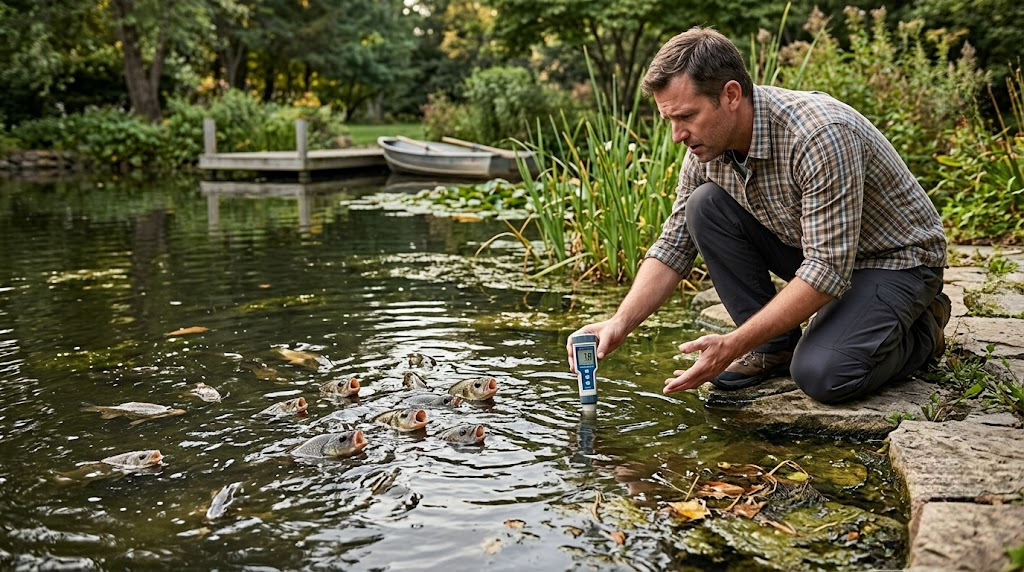
Dissolved oxygen is one of the most important indicators of pond and lake health. The appropriate dissolved-oxygen concentration depends on water temperature, fish species, stocking density, time of day, and the intended use of the waterbody. As a general guide, many warm-water fish perform best when dissolved oxygen stays above about 5 mg/L, while concentrations below about 3–4 mg/L may cause stress and require prompt attention. Cold-water species such as trout and salmon may require higher levels.
Dissolved oxygen normally reaches its lowest level shortly before sunrise because plants, algae, fish, and microorganisms consume oxygen throughout the night while photosynthesis has stopped. Low oxygen can stress or kill fish, contribute to anaerobic conditions and unpleasant odours, and impair overall water quality. Low oxygen can also cause poor water quality, odours, and algae growth.
Fortunately, a few signs can alert you before things get too bad. Identifying these signs early can help you act and protect your waterbody. Aeration provides movement and promotes oxygen distribution throughout the water. The right lake aeration system can also help to enhance circulation and minimize stagnant zones.
These signs do not prove that low dissolved oxygen is the only problem. Fish disease, ammonia, nitrite, toxins, pesticides, excessive nutrients, sudden temperature changes, turnover events, and other water-quality conditions can produce similar symptoms. Test dissolved oxygen, temperature, pH, ammonia, nitrite, and other relevant parameters before selecting a permanent treatment system.
Below are 10 red flags to watch for that may indicate your pond or lake needs some attention right away.
1. Fish Are Gasping Near the Surface
Fish may move toward the surface, inflows, fountains, or other better-oxygenated areas when dissolved oxygen becomes critically low. Surface gasping—especially shortly before or around sunrise—is a serious warning sign, although gill disease, elevated carbon dioxide, ammonia, nitrite, or toxic contamination can cause similar behavior.
If fish are actively gasping, measure dissolved oxygen immediately and begin appropriate emergency aeration or oxygenation while investigating the underlying cause.
Watch for:
- Fish gasping at dawn
- Fish gathering near the surface
- Unusual fish movement
- Sudden fish stress
These are important pond aeration signs. Act quickly if fish show severe oxygen stress.
2. Fish Deaths Occur Suddenly
Sudden fish kills may signal serious water quality issues. Photosynthesis stops at night, while fish, plants, algae, and microorganisms continue consuming oxygen. Dissolved oxygen therefore commonly reaches its lowest concentration shortly before sunrise. The risk may increase during warm weather because warmer water holds less dissolved oxygen while fish, algae, microorganisms, and decomposing organic matter may consume oxygen more rapidly.
A sudden fish kill is not always caused by low oxygen. Possible causes include toxic contamination, ammonia or nitrite, disease, extreme temperature changes, pesticide exposure, and rapid lake turnover. Test the water promptly rather than assuming aeration is the complete solution.
Mississippi State University identifies approximately 3–4 mg/L as a critical range for initiating aeration in intensively managed catfish ponds, but actual requirements vary by species and application.
How Aeration Supports Pond and Lake Health
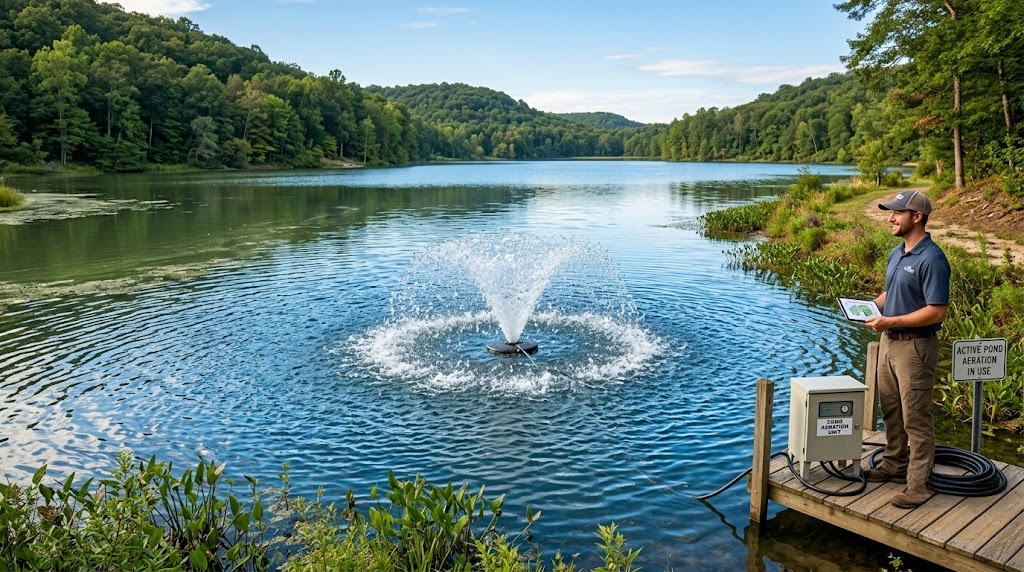
Aeration can increase gas exchange and create circulation within a pond or lake. Diffused-air systems generally produce rising bubble plumes that lift deeper water toward the surface, while surface aerators primarily agitate and oxygenate the upper water layer. The resulting circulation pattern depends on equipment type, water depth, placement, and operating conditions. It can also increase circulation and reduce stagnant areas.
Puroxi features aeration products designed for ponds, including systems that create bottom-up water movement. Select systems based on pond area, depth, total water volume, shape, organic loading, fish population, oxygen demand, climate, and treatment objectives.
Potential benefits:
- Better oxygen distribution
- Improved circulation
- Reduced stagnant areas
- Better aquatic conditions
- Support for algae management
- Reduced unpleasant odors
- Support for a broader water-quality management program
- Aeration does not guarantee continuous improvement if nutrient loading, contamination, excessive organic matter, or other underlying causes remain.
However, equipment should match the pond’s size, depth, shape, and oxygen demand.
Consider Advanced Oxygenation Options
Traditional aeration is not the only approach. Advanced oxygenation technologies can also support water management.
Puroxi Nano Bubble Nozzles can introduce ambient air or gases such as oxygen or ozone through the nozzle’s gas ports. Water enters one end of the nozzle and treated water exits the opposite end. The technology is designed to provide intense gas-water mixing and improve gas-transfer efficiency.
Nano Bubble Nozzles are not conventional pond aerators. They require a properly sized pump, gas supply where applicable, piping, and engineered water circulation. Express treatment capacity in both hourly flow and total 24-hour turnover. For example, a system processing 6 m³/h treats up to 144 m³ over 24 hours before accounting for actual operating conditions.
Advanced options may help with:
- Oxygen transfer
- Gas-water mixing
- Aquaculture applications
- Water circulation strategies
- Supplemental oxygenation
The right approach depends on water analysis and treatment objectives.
Take Action Before Pond Problems Become Severe
Often, you can catch problems before they cause major damage in your pond or lake. Address poor water quality and clarity, along with fish stress and odours, immediately.
First, test the water and then determine the source of oxygen depletion. Next, choose equipment based on your water body size, depth, flow, and treatment objectives.
Contact Puroxi for an application-specific evaluation of your pond, lake, or lagoon. Puroxi can assess conventional aeration, oxygen nanobubble systems, and ultrasonic algae-control technology based on water analysis, dissolved-oxygen measurements, water volume, depth, aquatic life, circulation requirements, and treatment objectives.
Immediate concerns include:
- Multiple dead fish
- Fish dying overnight
- Larger fish affected first
- Sudden changes after hot weather
A suitable lake aeration system can help circulate water and support oxygen distribution.
3. Water Develops a Strong Odor
Strong sulphur-like or rotten-egg odours can indicate anaerobic conditions and the production of hydrogen sulphide near bottom sediments. Other odours may come from algae, decaying vegetation, wastewater inputs, or organic contamination, so the source should be investigated. Unpleasant gases and compounds may be produced because of anaerobic processes. Persistent rotten-egg odours are not typical of a well-oxygenated waterbody and warrant further investigation.
Check for:
- Sulphur-like smells
- Rotten vegetation odours
- Strong odours near the shoreline
- Smells that worsen during warm weather
These conditions can signal a need for improved pond oxygenation and circulation.
4. Algae Growth Becomes Excessive
Excessive algae do not necessarily prove that aeration is required. Also evaluate nutrient inputs, sunlight, temperature, water residence time, and algae species. Aeration may support circulation and oxygen management, but you may still need nutrient control or another algae-management technology.
Where recurring algae are the principal problem, Puroxi Quattro ultrasonic algae-control technology may be considered as a separate treatment approach. Ultrasonic algae treatment and aeration serve different functions and should be selected based on site conditions and treatment objectives.
For waters containing fish, shrimp, shellfish, or other aquatic life, Puroxi recommends one or two Quattro DB 360 units—not the Globe, as the Globe may interfere with nutrients that marine life require. Consider that two DB 360 units are for deeper water to cover the photic zone.
Warning signs include:
- Thick surface mats
- Rapid algae growth
- Green or cloudy water
- Algae returning quickly after removal
Aeration can be used with other management practices to improve circulation and support overall water quality.
5. Water Becomes Dark or Murky
Sudden changes in water appearance deserve attention. Dark, cloudy, or murky water can result from algae, suspended clay, erosion, stormwater runoff, decaying organic matter, bottom-feeding fish, or sediment disturbance. Poor circulation may contribute in some waterbodies, but water appearance alone cannot confirm an oxygen problem.
Look for:
- Dark-colored water
- Cloudiness
- Floating organic debris
- Sediment accumulation
- Reduced water clarity
A properly sized lake aeration system can create circulation from deeper areas toward the surface. Puroxi can evaluate aeration, circulation, oxygen nanobubble, and ultrasonic algae-control options according to the waterbody’s size, depth, water chemistry, aquatic life, and treatment objectives.
6. The Pond Has Stagnant Areas
Still water can develop oxygen differences between shallow and deep areas. Bottom water may become oxygen-depleted, especially when organic material accumulates.
Stagnation may appear as:
- Little natural movement
- Dead zones
- Floating debris
- Uneven water conditions
- Poor circulation around corners
A properly designed aeration system can promote gas exchange and improve circulation. However, the equipment type, placement, and operating schedule must account for water depth, seasonal stratification, fish species, and temperature requirements. Improperly designed mixing can disturb bottom sediments or alter temperature and oxygen conditions too rapidly. This is particularly important in deep or stratified lakes. Bottom-up mixing should not automatically be recommended for every waterbody.
7. Excessive Organic Matter Builds Up
Leaves, grass clippings, dead algae, aquatic vegetation, uneaten feed, fish waste, and runoff can add organic matter to a pond or lake. Microorganisms consume oxygen as this material decomposes, potentially increasing biochemical oxygen demand and lowering dissolved-oxygen concentrations. Microorganisms use oxygen during decomposition. If oxygen demand becomes too high, water conditions can deteriorate.
Common sources include:
- Fallen leaves
- Grass clippings
- Dead algae
- Aquatic plants
- Organic runoff
You still need to remove some excess organic material. Aeration can improve circulation and support long-term water quality.
8. Fish Behavior Changes
Fish can indicate changes in water conditions early. If fish swim abnormally, it may be a sign of stress in their surroundings.
Watch for:
- Reduced feeding
- Unusual surface activity
- Fish crowding near inflows
- Slow movement
- Sudden behavioral changes
Don’t ignore these pond aeration signs. Test water conditions and consider professional assessment.
9. Seasonal Problems Keep Returning
Certain ponds have oxygen issues in the summer. As water temperature rises, oxygen levels drop, and biological activity may require more oxygen.
Recurring problems may include:
- Summer fish stress
- Repeated algae blooms
- Seasonal odors
- Morning oxygen depletion
- Recurring stagnant zones
A properly designed lake aeration system can provide continuous circulation during periods of higher oxygen demand.
10. Your Water Quality Keeps Declining
When several problems occur together, your waterbody may need a comprehensive management strategy.
Aeration alone cannot solve every water-quality problem. Still, it can become an important part of a broader treatment plan.
Consider evaluating:
- Dissolved oxygen levels
- Water temperature
- Algae concentrations
- Organic loading
- Water circulation
- Fish health
- Seasonal changes
Puroxi offers water-treatment solutions to ponds and lagoons and focuses on site-specific solutions depending on water conditions.
Frequently Asked Questions
Common pond aeration signs include fish gasping, odours, algae blooms, stagnant areas, and sudden water-quality changes.
Install a lake aeration system when oxygen depletion, stagnation, odours, or recurring seasonal problems threaten aquatic health.
Pond oxygenation improves circulation and distributes oxygen, supporting healthier aquatic conditions and biological processes.
Yes, aeration can support water quality improvement by improving circulation, oxygen distribution, and overall aquatic conditions.
These systems can be configured for water treatment, aquaculture, pond, lake, and lagoon applications that require efficient oxygen transfer and gas-water mixing, potentially complementing conventional aeration in suitable applications. and mixing, potentially complementing conventional aeration in suitable applications.
