Puroxi Knowledge Centre
Legionella Risk Management in Industrial Cooling Towers: A Technical Guide
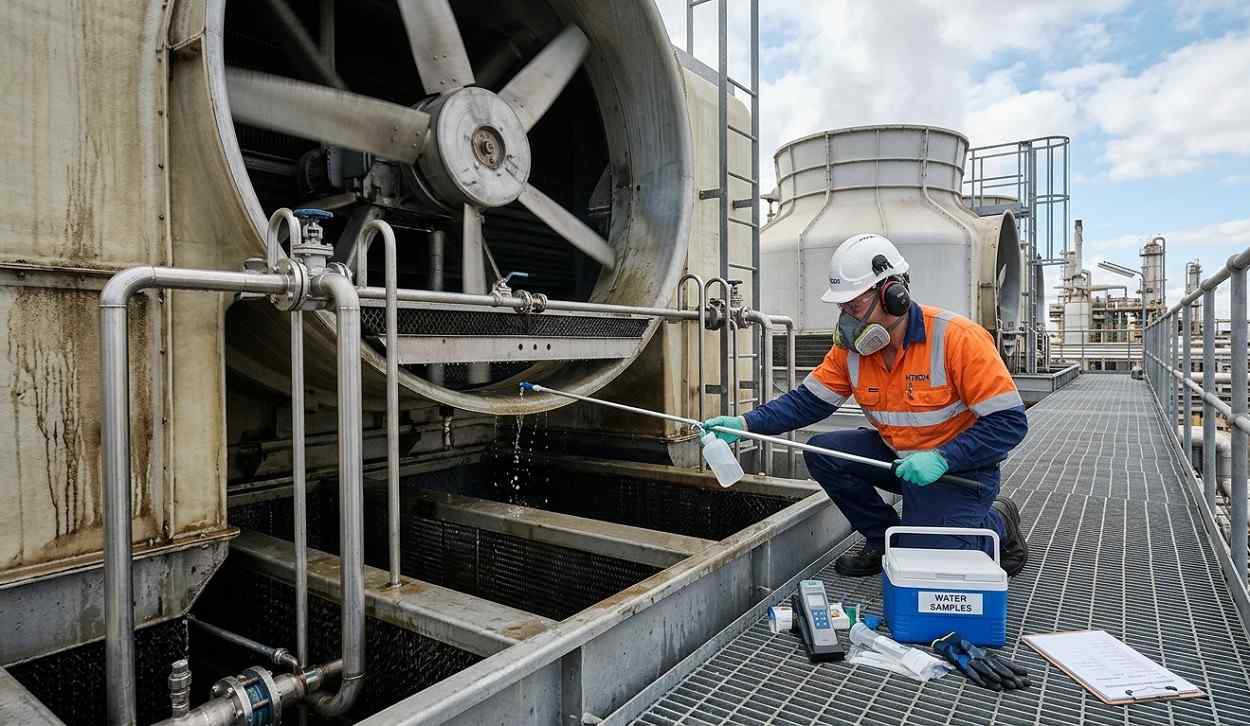
Cooling towers in industries are important in rejecting heat. But they also create conditions that favor bacterial growth. Legionella is one of these bacteria that pose health hazards. Thus, safe operations become critical to proper risk management.
Legionella bacteria are known to grow in warm water systems. Cooling towers offer optimal temperatures, nutrients, and moisture. Consequently, bacteria grow very quickly when unchecked. Additionally, the polluted aerosols may be spread in the air. This proliferation exposes the risk of infection.
Understanding Legionella in Cooling Towers
Legionella causes Legionnaires’ disease, a deadly type of pneumonia. People contract it by inhaling contaminated droplets. So, plants should regulate bacterial growth.
Cooling towers are usually used at temperatures between 20 degree C and 45 degree C. This is the temperature range that favors bacteria. Also, stagnant areas and biofilm development exacerbate the issue. Therefore, operators need to address these risk factors.
Important Risk Factors in Cooling Towers
Several factors increase the risk of Legionella growth. Their identification is useful in the development of effective control measures.
- Warm water temperatures: Promote bacterial multiplication
- Biofilm formation: Protects bacteria from disinfectants
- Scale and corrosion: Provide surfaces for microbial growth
- Stagnant water zones: Reduce disinfectant circulation
- Poor maintenance: Leads to system inefficiencies.
Due to the frequent combination of these factors, the risk level may increase rapidly. Therefore, routine checks are essential.
Elements of a Good Risk Management Plan
An effective risk management plan will provide stability in controlling Legionella. It integrates monitoring, treatment, and maintenance plans.
System Assessment
First, check the cooling tower design and operation. Determine dead zones, low-flow zones, and contamination risks. This is to aid in the targeted approach to problem areas.
Water Treatment Program
Second, adopt a sound water treatment strategy. Apply biocides to inhibit microbial growth. Additionally, apply scale inhibitors and corrosion inhibitors.
- Oxidizing biocides for rapid disinfection
- Non-oxidizing biocides for long-lasting control
- Anti-scalants to prevent mineral buildup.
Thus, a balanced chemical program guarantees the cleanliness and safety of the system.
Monitoring and Testing
Early warning is given by regular monitoring. Check the water for microbes and the chemical balance. Consequently, the operators will be able to modify treatment programs quickly.
Common monitoring practices include:
- Measuring biocide levels
- Checking pH and conductivity
- Testing for Legionella presence
Regular testing enhances a system’s reliability and minimizes risk.
Cleaning and Maintenance
Periodic cleaning removes biofilm, sludge, and debris. Bacteria seek protection and food without cleaning. As such, planned maintenance is important.
- Clean basins and fill materials
- Inspect drift eliminators
- Remove scale and corrosion deposits.
- Regular maintenance enhances the efficiency and safety of the systems.
Role of Automation in Risk Control
The contemporary cooling towers have automated control systems. These systems ensure real-time monitoring of water quality. Thus, they automatically regulate chemical doses. Automation minimizes human error. It also guarantees uniform biocide levels. Besides, it enhances the speed of response to fluctuations.
Parameters tracked include pH, ORP, and conductivity. Controllers use this data to maintain optimum conditions. This leads to improved operator control of Legionella risks.
Importance of Documentation and Compliance
Regulatory policies need to be well-documented. The facilities should keep records of inspections, testing, and maintenance. Thus, accountability and compliance are guaranteed by documentation.
The authorities frequently perform audits. Safety standards are met through proper records. Also, they help identify recurring problems.
Emergency Response Planning
Although precautions are taken, there could be risks. Facilities are thus required to make emergency response plans.
- Immediate system shutdown if contamination occurs
- Shock dosing with high-level biocides
- Isolation of affected areas
- Communication with health authorities.
Early response minimizes exposure and safeguards human health.
Training and Awareness
Risk management is an important role played by trained personnel. Employees should learn how to use the system and safety measures. That is why regular training is necessary.
Training should cover:
- Identification of risk factors
- Proper chemical handling
- Monitoring techniques
- Emergency procedures
Trained personnel will ensure that safety precautions are always taken.
Advanced Solutions for Legionella Control
Amidst contemporary industrialization, firms such as Puroxi offer innovative water purification options. Their technologies assist in the growth of microbes. As a result, industries can enjoy safer, more reliable cooling tower operations.
Advanced solutions include:
- Automated dosing systems
- High-efficiency biocides
- Real-time monitoring tools
- Integrated control platforms
These technologies improve the performance with minimal manual input.
Best Practices Year-Round Control
To ensure control all year round, it must be consistent. Seasonal changes may influence water quality and bacterial growth.
- Monitor more in the warmer months.
- Modify chemical doses with temperature.
- Avoid water stagnation when shutting down.
- Periodic system checks.
Thus, an aggressive strategy will guarantee ongoing security.
Environmental and Operational Advantages
There are numerous benefits to effective Legionella management. It enhances safety and efficiency.
- Reduces health risks
- Enhances system performance
- Extends equipment lifespan
- Lowers maintenance costs
In addition, cleaning systems are more efficient. This productivity minimizes energy usage and environmental cost.
In industrial cooling towers, Legionella risk management is a critical issue. Bacteria can easily multiply and cause severe health complications without adequate control. So, facilities should go with an integrated approach.
Industries can reduce risks by integrating activities such as monitoring, treatment, maintenance, and training. Furthermore, the current technologies facilitate the process and enhance results. Industries such as Puroxi still rely on companies that offer innovative solutions for operating safely.
Frequently Asked Questions
Warm water, biofilm formation, and stagnant zones create ideal conditions for Legionella bacterial growth.
Facilities should test regularly, typically monthly, depending on risk level and regulatory requirements.
Oxidizing and non-oxidizing biocides effectively control Legionella when applied with proper dosing strategies.
Yes, automation maintains consistent chemical dosing and monitoring, reducing human error and improving system safety.
Cleaning removes biofilm, sludge, and debris that support bacterial growth and protect Legionella colonies.