 Skip to content
Puroxi Knowledge Centre
Chemical Treatment for Cooling Towers: Best Practices for Safety and Compliance
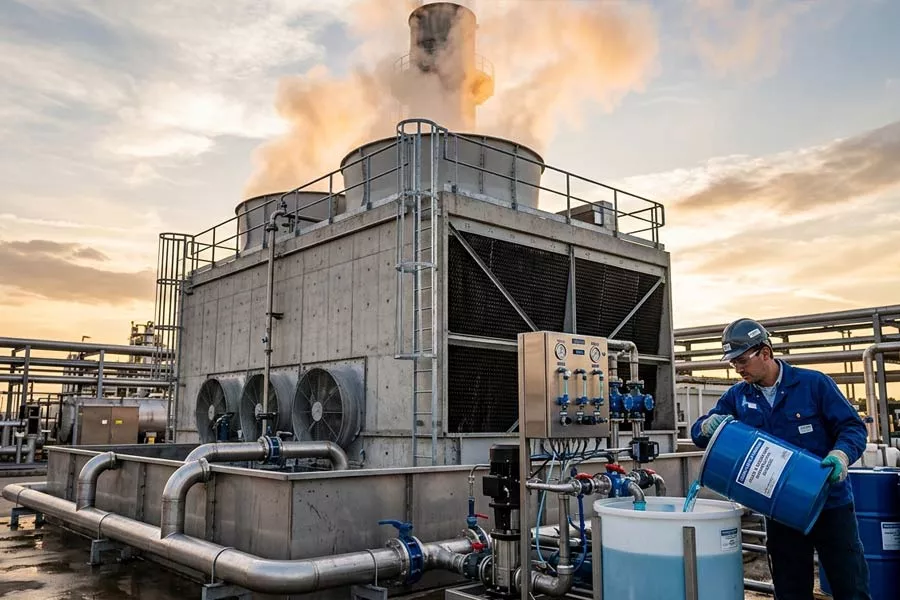
Cooling towers are essential in industrial and commercial activities. They are effective at heat removal and facilitate sustained performance. However, they may cause severe problems unless they are properly treated with chemicals. Therefore, companies need to adhere to best practices to ensure safety and compliance.
The importance of Chemical Treatment
Water used in cooling towers constantly circulates. This makes them pick up impurities such as dirt, bacteria, and minerals. These factors decrease productivity and increase operational risks. In addition, raw water may lead to corrosion, scaling, and biological growth.
Proper chemical treatment helps you:
- Avoid the accumulation of scale on heat-exchange surfaces.
- Prevent metal component corrosion.
- Get rid of dangerous bacteria, such as Legionella.
- Enhance system efficiency and life.
- Minimize long-term maintenance expenses.
Thus, companies should use a systematic treatment plan at the earliest stage.
Common Risks in Untreated Cooling Towers
Without chemical treatment, several issues can arise within a short time. To start, scaling inhibits heat transfer. Consequently, energy consumption increases. Second, corrosion destroys pipes and equipment. This increases the cost of repair.
Also, biological development poses health risks. For example, bacteria may be transmitted via airborne droplets. This may result in critical compliance breaches. Thus, prevention is necessary rather than optional.
Key Chemicals Used in Treatment
Various chemicals are used in cooling towers. You should choose them according to the water quality and system design.
1. Corrosion Inhibitors
These are metal-protecting chemicals. They form a barrier that prevents oxidation. Consequently, equipment has a longer life.
2. Scale Inhibitors
Scale inhibitors decrease mineral deposits. They ensure the surfaces are clean and efficient. Thus, systems are maintained in optimal performance.
3. Biocides
Biocides control microbial growth. They destroy bacteria, algae, and fungi. They, therefore, enhance safety and hygiene.
Dispersants
The dispersants suspend particles in water. This procedure eliminates accumulation on surfaces. Consequently, it becomes simple to clean.
Best Practices of Safe Chemical Treatment
To be safe and comply, best practices should be followed. These measures can ensure system efficiency and minimize risks.
Regular Water Testing
To begin with, test the water quality regularly. This measure helps detect imbalances early. Thus, you can fine-tune chemical levels.
Accurate Chemical Dosing
Must have appropriate dosing levels. Excessive dosing wastes chemicals and adds to expenses. Conversely, underdosing is ineffective. So, dosage is to be monitored at all times.
Automated Treatment Systems
Whenever possible, use automated systems. The systems are used to ensure uniform application of chemicals. Consequently, there is a reduction in human errors.
Routine Maintenance Checks
Inspect cooling towers regularly. Check for scaling, corrosion, or biological growth. As a result, you can solve problems before escalating.
Awareness and Training of Staff
Educate your staff. They should be aware of the chemical handling practices. In addition, they are supposed to adhere to safety measures.
Trusted solutions such as Puroxi can be placed in the centre of your compliance strategy to facilitate the smooth running of treatment processes and to maintain reliable performance.
Safety Guidelines for Handling Chemicals
There are potential hazards in chemical treatment. Hence, safety should be a priority at all times.
- Always use protective equipment, such as goggles and gloves.
- Keep chemicals in the store-marked containers.
- Follow instructions; be careful with the manufacturer.
- Do not mix incompatible chemicals.
- Proper ventilation in treatment areas.
Also, prepare emergency response plans. This arrangement will reduce risks in unforeseen circumstances.
Compliance with Regulations
The operations of cooling towers should comply with local and international requirements. These regulations guarantee safety and the environment.
To begin with, keep a good record of chemical use. This record aids in inspections. Second, follow guidelines for water discharge and waste management. As a result, you lessen environmental impact.
In addition, most areas need Legionella risk management plans. Thus, frequent monitoring and reporting would become necessary. Not only does compliance protect your reputation, but it also avoids penalties.
Benefits of Following Best Practices
There are several benefits to practicing proper chemical treatment. To begin with, there is an increase in system efficiency. Consequently, energy costs are reduced.
Second, the equipment’s lifespan is increased. Thus, you save replacement costs. Third, it is easier to comply. As a result, you will not get into legal issues. Also, a properly maintained system provides a safer workplace environment. This advantage increases the reliability of the operations.
Choosing the Right Treatment Partner
Choosing the proper partner is key to success. You need specialists who know what systems you require. They are expected to provide personalized solutions to your needs.
Find providers that provide:
- Comprehensive water analysis services
- Advanced treatment technologies
- Continued observation and assistance.
- Strong compliance knowledge
Finally, trusted partners such as Puroxi enable safety and efficiency, as well as regulatory compliance, without any trouble. The use of chemicals in the cooling tower is critical to safe and effective processes. In its absence, systems are prone to scaling, corrosion, and biological hazards. This means businesses should embrace best practices.
Regular testing, proper dosing, and appropriate safety precautions guarantee optimal outcomes. In addition, adherence to rules ensures the safety of your operations and the environment. With these tips and by working with trusted professionals such as Puroxi, you can keep a reliable, efficient cooling system in place over the years.
Chemical treatment prevents scaling, corrosion, and bacteria growth, ensuring efficient, safe, and compliant cooling tower operation.
You should test water regularly, ideally weekly, to maintain proper chemical balance and system performance.
Workers must wear protective gear, follow instructions, avoid mixing chemicals, and ensure proper ventilation always.
Yes, automated systems maintain consistent dosing, reduce human error, and improve overall treatment efficiency significantly.
It ensures controlled discharge, prevents harmful bacteria growth, and supports adherence to safety and environmental standards.
