Water Quality for Livestock and Poultry
Water is a daily input to livestock and poultry production. Its value depends not only on appearance but on microbiological quality, mineral content, palatability, temperature, availability and the condition of storage and distribution equipment.
Start with source, demand and distribution
Record whether water comes from a well, dugout, pond, municipal supply or blended source. Determine normal consumption and peak demand during hot weather or high-production periods. A treatment system must maintain required flow and pressure at the furthest drinker while preserving adequate contact time.
Useful water information
The appropriate testing panel depends on species, age, production system, source and location. Review may include microbiology, pH, hardness, alkalinity, conductivity or total dissolved solids, iron, manganese, sulphates, nitrates, nitrites and other locally relevant substances.
Water temperature, odour, taste, sediment and colour should be documented, but visible clarity cannot establish suitability. A qualified veterinarian, nutritionist, laboratory or responsible authority should interpret animal-health concerns.
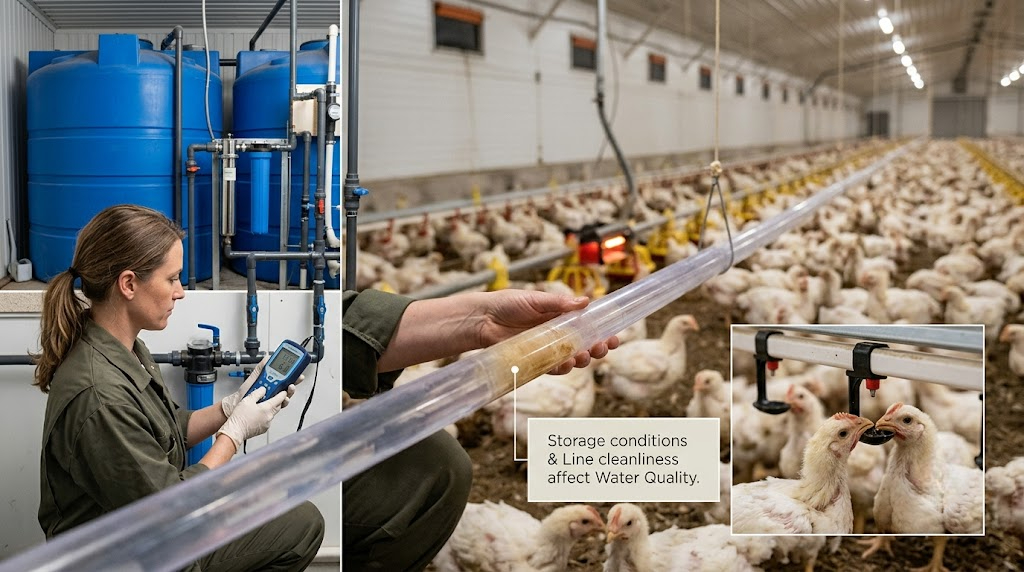
Storage tanks and drinker lines can change the water
Water may leave the source in acceptable condition and deteriorate through warm storage, sediment, low-flow areas, biofilm, leaking drinkers or poor flushing. Samples from both the source and the point of use help separate source-water problems from distribution-system problems.
Treatment must be controlled and verified
Puroxi Oxygen Booster may be introduced through an appropriately selected peristaltic dosing pump from a labelled barrel into the water line. The feed rate is based on the water condition, system flow, treatment objective and required verification. It must not be hand-poured into an active drinking system as a substitute for controlled dosing.
Where gas transfer is appropriate, a Puroxi Nano Bubble Nozzle system may use ambient air or oxygen to support circulation and dissolved-oxygen objectives in a dugout, reservoir or storage application. The pump, nozzle, gas supply and distribution layout are designed around the water body and demand.
Practical monitoring plan
- Test untreated source water and representative points of use.
- Record daily consumption and peak-demand pressure.
- Inspect tanks, filters, regulators, nipples and end-of-line condition.
- Document treatment concentration or residual where applicable.
- Flush and clean according to the approved farm procedure.
- Track water results alongside temperature, flock/herd stage and operational changes.
- Do not attribute animal-performance changes to one treatment without suitable evidence.
Questions Puroxi will ask
- Species, number and production stage.
- Water source, storage volume and distribution layout.
- Daily and peak consumption.
- Pipe sizes, pressure, filters and existing dosing equipment.
- Current laboratory results and visible problems.
- Products already added to feed or water.
- Required outcome and monitoring capability.
PUROXI PRINCIPLE
Understanding Always Comes Before Recommendation.