Five stages of generation
Water circulation, gas introduction, gas dispersion, bubble stabilization and gas transfer.
Puroxi nano bubble learning centre
Learn how the nozzle, pump, piping, gas source, manifolds, operating practices and verification measurements work together.
The approved operating relationship
Water is pumped into one end of the Puroxi Nano Bubble Nozzle and treated water exits the opposite end. Gas is introduced through the supplied gas ports. The selected nozzle model, actual flow, operating pressure and gas delivery must work as one system.
Learning pathway
Water circulation, gas introduction, gas dispersion, bubble stabilization and gas transfer.
Water enters one end and exits the opposite end while gas reaches every supplied top and bottom gas port.
Very small size reduces buoyant rise while Brownian motion, drag, internal pressure and surface charge influence behaviour.
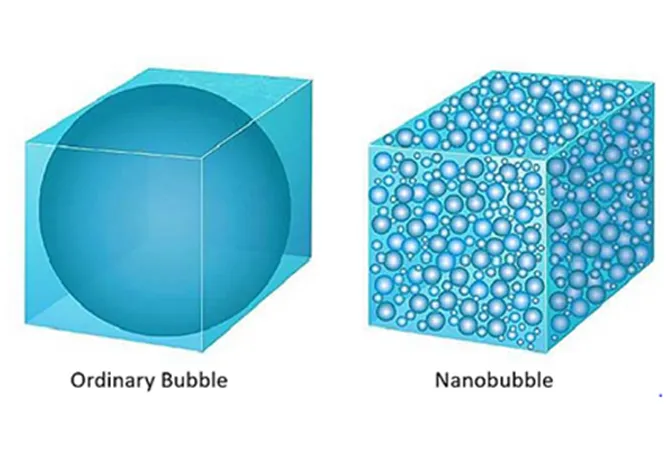
For the same gas volume, dividing gas into smaller bubbles creates much more gas-to-water contact area.
Treatment volume, actual pump flow, pressure, TDH and the required operating schedule determine the hydraulic pathway.
Balanced branch lengths, suitable pipe size and every manifold fitting must be included in total head loss.
A suitable PSA oxygen source may supply the gas side through regulation, flow control, compatible tubing and monitoring.
Record baseline readings, inspect restrictions, isolate energy before service and follow the current manual.
Bubble scale and contact area
Large bubbles rise rapidly and provide limited contact time. As gas is divided into much smaller bubbles, the total gas-water interface increases and the bubbles can remain dispersed longer. Actual transfer still depends on gas, water chemistry, temperature, salinity, depth, flow and system design.
Why suspension differs
Optional integrated oxidation pathway
A Puroxi nozzle system may be designed around ambient air, oxygen, ozone, carbon dioxide, nitrogen or another compatible gas. Where the treatment plan calls for it, a controlled peristaltic pump can introduce an approved peroxide product into a separately engineered injection point.
The objective may include dissolved-oxygen support, oxidation, aerobic biological activity, odour management, biofilm control, clarity or process-water improvement. Water testing, chemical compatibility, dosage control, ventilation, monitoring and applicable regulations determine the final pathway.
System-design pathways
Pressure, TDH, pump curves, materials, VFDs and installation environment.
Open →Nozzle, pump, gas, manifolds, monitoring and independent ultrasonic layouts.
Open →Practical volume and ideal-turnover starting calculations.
Open →Preparation, start-up, shutdown, cleaning, safety and documentation.
Open →On-site oxygen preparation and controlled gas delivery.
Open →Controlled manuals, specifications and design references.